
The radiators are barely warm on a cold October morning. The boiler has locked out, and when you crouch down to look, the pressure gauge is sitting at zero.
If that sounds familiar, this guide is for you. Low pressure is one of the easiest boiler faults to fix and one of the easiest to misdiagnose. Below I explain how to repressurise a boiler safely, what the steps look like on Worcester Bosch, Vaillant, Ideal and Baxi boilers, and the point where topping up stops being the answer.
I’m a Gas Safe registered engineer (559988) covering Greater Manchester from a base in Astley, and I’ve written this the way I’d explain it standing in your kitchen: plain steps, the real safety limits, and a clear line for when to stop and call someone.
Quick answer
Switch the boiler off and let it cool. Open the filling loop valves slowly until the gauge reads between 1.0 and 1.5 bar, then close both valves and disconnect the loop if it is removable. Switch the boiler back on. If the pressure drops again within a few days, something is leaking and topping up will not fix it.
What should my boiler pressure be?
Look for the gauge or digital display on the front or underside of the boiler. Older boilers have a dial with a green zone. Many newer ones show the pressure as a number on the screen. Cold, it should sit between 1.0 and 1.5 bar. It rises by up to about 0.5 bar when the heating runs, because heated water expands. That is normal.
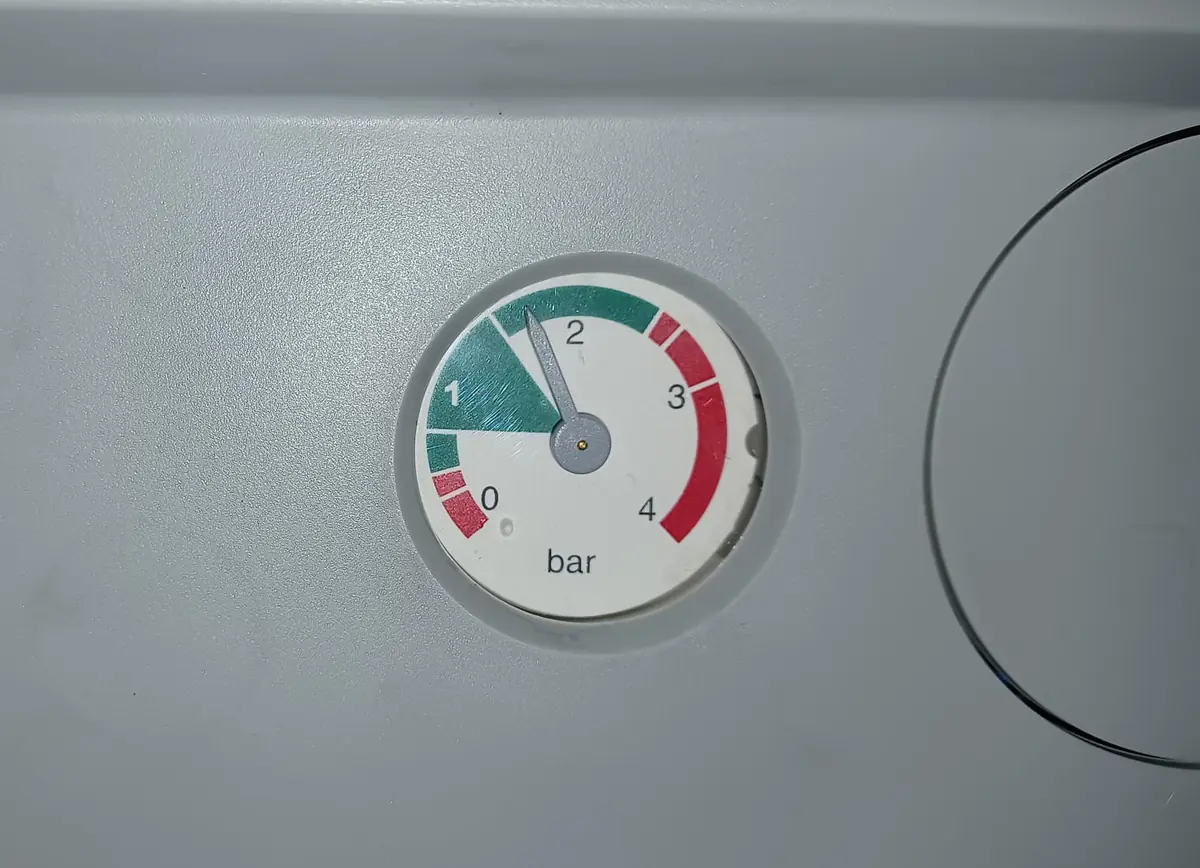
| Reading | What it means | What to do |
|---|---|---|
| Below 1.0 bar, or needle in the red | Too low. The boiler may lock out or run poorly | Repressurise using the steps below |
| 1.0 to 1.5 bar (cold) | Normal | Leave it alone |
| Up to about 2.0 bar (heating running) | Normal as the water expands | Leave it alone |
| Above 2.5 bar | Too high | Switch off, let it cool, bleed a radiator slightly. Call me if it climbs again |
| 3 bar | The pressure relief valve opens and discharges water outside | Call a Gas Safe engineer |
Before you start: five safety checks
- No gas smell and no carbon monoxide alarm. If you smell gas or your CO alarm sounds, stop. Open windows and doors, don’t touch any switches, leave the property and call the National Gas Emergency Service on 0800 111 999 (free, 24 hours). Cadent’s gas safety advice lists the warning signs of carbon monoxide poisoning: headaches, dizziness, breathlessness, nausea, collapse and loss of consciousness.
- Boiler off and cool. Switch the heating and hot water off at the boiler and wait until the pipes are cool to touch. Adding cold water to a hot system is how people get burnt.
- Know your filling loop. It is the link between your mains water and your heating system, usually under the boiler. There are three types: a braided hose with two taps, a keyed internal loop, and a keyless lever. Check your handbook or the model label.
- Never open the boiler casing. Topping up pressure never needs it. Only a Gas Safe registered engineer should go inside a gas boiler.
- Keep a towel handy. Filling loops drip when you disconnect them.
How to repressurise a boiler: the steps that apply to every model
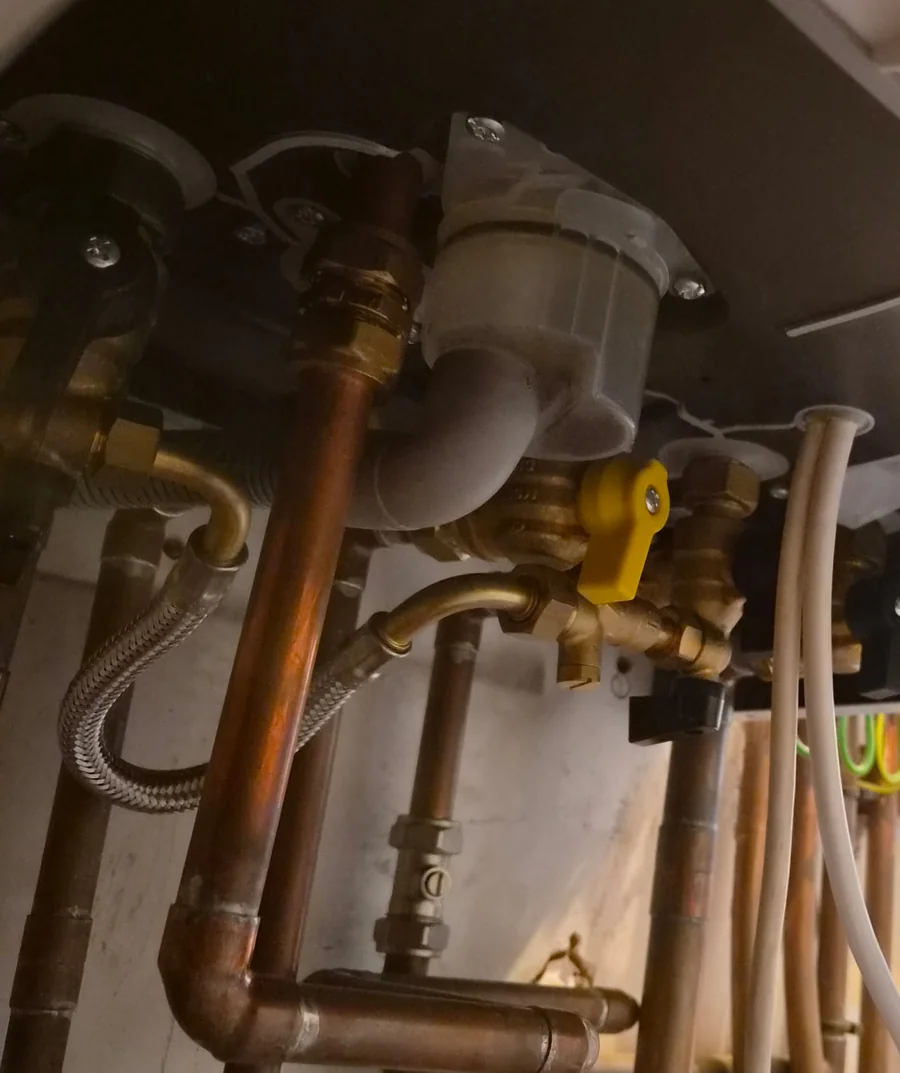
- Switch the boiler off and let it cool.
- Find the filling loop under the boiler. If you have a braided hose, make sure both ends are properly connected.
- Open the valves slowly. Turn both valves (or the lever) a little at a time. You should hear water flowing. It goes in faster than you expect.
- Watch the gauge. Stop when it reads between 1.0 and 1.5 bar. Do not go above 1.5 bar.
- Close both valves fully. Turn them firmly until they stop.
- Disconnect the loop if it is a removable hose, and dry the ends. A hose left connected can push the pressure up and is not meant to stay attached.
- Switch the boiler back on. Some boilers need the reset button pressed. Give it a few minutes, then check the gauge again. Cold, it should still read between 1.0 and 1.5 bar.
If you overshoot, don’t panic. Switch off, let it cool, and bleed a radiator slightly until the gauge drops back into range.
Brand by brand: Worcester Bosch, Vaillant, Ideal and Baxi
The steps above are the same everywhere. What changes is the hardware under the boiler. I’ve checked each manufacturer’s own guidance below. Always follow the handbook for your exact model.
Worcester Bosch (including the Greenstar 4000)
Worcester Bosch fits three types of filling loop, so check which one you have first.
- Keyless internal loop: a blue lever at the bottom of the boiler. Pull it down and release it once the gauge passes 1 bar.
- Keyed internal loop: a white filling key kept under a flap beneath the boiler. Push it into the port, line its arrow up with the open-padlock symbol, turn it, and watch the gauge rise to just over 1 bar. Turn the key back to the open-padlock position and remove it. Expect a few drips.
- External loop: a braided hose with two taps. Connect it, open the mains cold tap first, then the second tap, and stop at about 1 bar.
Worcester Bosch shows each type in its own boiler pressure guide. Check your Greenstar handbook to see which one yours has.
Vaillant (including the ecoTEC)
On a Vaillant, the filling loop is a flexible hose or a lever connecting two valves under the boiler, sometimes behind a removable panel. Turn both valves (or the lever) slowly anticlockwise, watch the gauge or display, and close them clockwise once it reaches 1.0 to 1.5 bar. Detach the loop if it comes off, then recheck the reading after the boiler has heated up. Vaillant says not to let the pressure go above 2.5 bar. Its repressurising guide has more detail.
Ideal (including the Logic)
Ideal’s guidance is to switch off and let the boiler cool, check both ends of the filling loop are connected, open both valves and listen for water flowing, then close them once the gauge reaches 1.5 bar and restart the boiler. Ideal also warns that repeatedly topping up with plain water dilutes the inhibitor that protects your system from corrosion. That is another reason not to keep doing it. Read Ideal’s pressure-loss guide.
Baxi
Baxi’s advice is video-based and varies by model, so I’d rather point you to Baxi’s official top-up guide than describe a method that might not match your boiler. The same rules still apply: boiler off and cool, 1.0 to 1.5 bar, close everything, disconnect the loop.
After you’ve topped up
Check the gauge once the heating has run, and again the next morning. A cold reading that holds between 1.0 and 1.5 bar means the job is done. A reading that has fallen means water is leaking out somewhere.
Why does my boiler keep losing pressure?
A sealed heating system has nowhere for water to go. If the pressure falls, water or air is escaping. These are the usual causes, starting with the harmless one:
- You bled a radiator. Bleeding lets air out, and the pressure drops with it. One top-up afterwards is normal.
- A leak at a radiator valve, pipe joint or under the floor. Look for damp patches, stained ceilings, a wet carpet, or green or white crust on fittings.
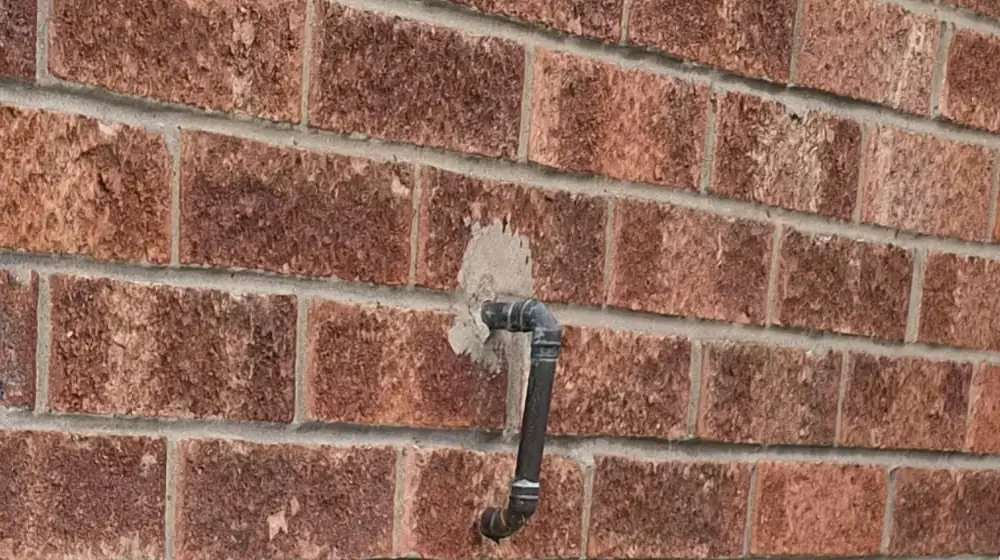
- A weeping pressure relief valve. This safety valve opens at 3 bar, but a worn one can drip at lower pressure. Look for a copper pipe that leaves the boiler and goes through an outside wall, and check the end of it for drips or a dark stain.
- A failed expansion vessel. If the pressure shoots up every time the heating runs and falls back below 1 bar when cold, the vessel has probably lost its air charge or its diaphragm has failed.
- A faulty auto air vent, or air in the system. Small vents let air out, but a failed one can let it in.
- A fault inside the boiler, such as a heat exchanger or internal seal. This is a Gas Safe job only.
How often is too often to top up?
Once or twice a year, usually after bleeding radiators, is normal. If you are topping up more than twice in a month, there is a leak somewhere in the system. That is not a repressurise job. It is a leak detection job. The sensible order is to locate the leak first, rather than lift floorboards on a guess.
Keep topping up with plain water and you also dilute the inhibitor that stops your radiators rusting from the inside. That leads to sludge, cold spots and, eventually, a power flush or a failed boiler.
Two pressure call-outs from Greater Manchester
Wigan: no heating on a cold December morning
A family in Wigan had no heating or hot water. I was with them within 45 minutes. The pressure relief valve had discharged and the system could not build pressure, so topping up would have done nothing. I replaced the valve with a spare from the van, repressurised the system, and had the heating running before midday.
Hazel Grove: topped up twice, never fixed
A homeowner in Hazel Grove had a fourteen-year-old Ideal Logic combi that had been losing pressure on and off for months. Another contractor had repressurised it twice without finding the cause. When I checked the system, I found a weeping pressure relief valve and a small pinhole leak on a copper manifold fitting in the airing cupboard. I repaired both on the same visit. I also completed the boiler service, which was overdue, and it found a deteriorating heat exchanger seal.
Same symptom, two different causes. In both cases the real fix was finding the fault, not adding more water.
Diagnose by symptom: what your gauge is telling you
The same low reading can have very different causes. This is how I narrow it down before touching anything.
| What you see | Most likely cause | What to do |
|---|---|---|
| Pressure dropped right after you bled a radiator | Air released, so the system needs one top-up | Repressurise once, then check again next day |
| Slow fall over days or weeks, no visible water | Small leak at a joint, valve or under a floor | Book a leak detection visit |
| Pressure falls when the heating runs, then recovers | Air in the system, or a failing auto air vent | Bleed radiators, then call if it repeats |
| Pressure shoots above 2.5 bar when heating runs, then drops below 1 bar when cold | Failed expansion vessel (lost air charge or split diaphragm) | Call a Gas Safe engineer |
| Water dripping from the pipe on the outside wall | Pressure relief valve discharging | Switch off and call a Gas Safe engineer |
| Pressure drops again within days of every top-up | Leak, or a fault inside the boiler | Stop topping up and book a boiler repair |
Does my type of boiler or system matter?
Yes. This guide is for sealed systems, which is nearly every combi and system boiler fitted today. They have a pressure gauge and a filling loop. A heat-only (conventional) boiler with an open-vented system is fed by a small tank in the loft and has no filling loop to use, so there is nothing to repressurise. If your boiler has a gauge but you cannot find a loop, check the handbook before you do anything else, and call an engineer if you are still unsure.
Common mistakes I’d ask you to avoid
- Topping up with the boiler hot. The gauge reads higher when hot, so you end up underfilled or tempted to overfill.
- Going above 1.5 bar “to be safe”. More pressure does not mean more heat. It stresses the system and the pressure relief valve.
- Leaving the filling loop connected. Mains pressure can then push the system pressure up on its own.
- Topping up again and again. Each top-up puts fresh oxygenated water in and dilutes the inhibitor.
- Ignoring a drip from the outside pipe. That pipe is the pressure relief valve discharge. A drip there is a warning sign.
Boiler pressure terms in plain English
- Bar: the unit boiler pressure is measured in. A healthy cold sealed system reads 1.0 to 1.5 bar on the gauge.
- Filling loop: the short link between the mains cold water and the heating circuit, used to add water.
- Pressure relief valve (PRV): a safety valve that opens at 3 bar and sends water out through a discharge pipe, usually through an outside wall.
- Expansion vessel: a small air-charged tank that absorbs the extra volume as heated water expands.
- Inhibitor: a chemical in the system water that stops radiators and pipework corroding from the inside.
- Lockout: the boiler shutting itself down because a safety condition, such as low pressure, has not been met. Many boilers also show a fault code. Check the handbook for yours, as codes vary by make and model.
When to stop and call a Gas Safe engineer
Stop and call if any of these apply:
- You smell gas or your CO alarm sounds. Call 0800 111 999 first, then me.
- Water is leaking from the boiler or its pipework.
- The pressure won’t rise above 1 bar with the valves fully open.
- The pressure drops again within a few days.
- The pressure relief valve is dripping outside.
- The pressure climbs above 2.5 bar whenever the heating runs.
- You can’t tell which filling loop you have.
Repeatedly losing pressure? I’ll diagnose the real cause.
I attend emergency call-outs across Greater Manchester and aim to be with you within 60 minutes. You agree a fixed price before I start any work. See my boiler repair service or call 07826 088938.
Is it time for a new boiler?
Sometimes the fault is the boiler’s age. A homeowner in Walkden called me about an ageing combi that was losing pressure weekly and struggling to heat the upstairs radiators. After a full survey, the homeowner and I agreed a like-for-like combi replacement with a magnetic filter to protect the new boiler’s heat exchanger, and the job was done in a day. That pattern, weekly top-ups plus poor heat upstairs, is often a sign the boiler’s own seals, heat exchanger or expansion vessel are wearing out.
As a rule, if your boiler is under 10 years old, repair is almost always the better value. If it is 12 to 15 years old, has had several faults and parts are getting hard to find, replacement is worth pricing. My 10-sign boiler replacement checklist and my guide to boiler repair or replacement will help you decide. If you want to understand what causes repeated boiler pressure loss, and what a replacement costs, my complete Manchester boiler guide covers both.
Keeping your pressure steady through winter
- Check the gauge on the first of every month, and after bleeding any radiator.
- Book an annual service. It includes checking the expansion vessel and system pressure. A boiler service in Greater Manchester starts from £90, and most manufacturer warranties depend on a yearly service. On a recent annual service for a repeat customer in Swinton, the visit covered combustion analysis, the condensate trap, the expansion vessel pressure, an inhibitor test, a magnetic filter clean and a pressure reset.
- Ask for an inhibitor test if you have been topping up often. If the water is sludgy, a flush may be needed. Not every system benefits, and I’ll tell you if yours won’t.
- Learn where your filling loop is before you need it. Take a photo of it on your phone.
Frequently asked questions
What should my boiler pressure be?
When the boiler is cold, the gauge should read between 1.0 and 1.5 bar. It can rise to about 2 bar while the heating is running. Below 1 bar is too low and the boiler may lock out. Above 2.5 bar is too high, and the pressure relief valve opens at 3 bar.
How do I repressurise my boiler?
Switch the boiler off and let it cool. Open both valves on the filling loop slowly until the gauge reads 1.0 to 1.5 bar. Close both valves, disconnect the loop if it is removable, then switch the boiler back on. Some models need the reset button pressed. Check your handbook for your filling loop type.
Can I repressurise a boiler while it is on?
No. Vaillant, Ideal and Glow-worm all tell you to switch the boiler off and let it cool first. Adding cold water to a hot system risks burns, and the gauge reads higher when the water is hot, so you would not fill to the right level. Wait until the pipes are cool to touch.
Why does my boiler keep losing pressure?
The usual causes are a leak at a radiator valve or pipe joint, a weeping pressure relief valve, a failed expansion vessel or air vent, or a radiator you bled recently. One or two top-ups a year is normal. If the pressure keeps dropping, water is escaping somewhere and an engineer needs to find it.
How often is too often to top up boiler pressure?
Once or twice a year, usually after bleeding radiators, is normal. If you need to top up more than twice in a month, there is a leak somewhere in the system. Repeated top-ups also dilute the inhibitor that protects your radiators from rust, so book a Gas Safe engineer to find the cause.
Why won’t my boiler pressure go up?
Check both filling loop valves are fully open and the loop is connected at both ends. If water flows but the gauge does not move, the gauge or pressure sensor may be faulty. If no water flows, a valve may be seized. Stop there and call a Gas Safe registered engineer.
What happens if boiler pressure is too high?
If it passes about 2.5 bar, switch the boiler off and let it cool. You can lower it by bleeding a radiator slightly until the gauge is back at 1.0 to 1.5 bar. At 3 bar the pressure relief valve opens and discharges water outside. If it keeps climbing, the expansion vessel may have failed, so call an engineer.
Is it safe to repressurise a boiler myself?
Yes, if you follow your manufacturer’s instructions. It only means adding cold mains water through the filling loop and never involves opening the boiler. Stop and call a Gas Safe registered engineer if you smell gas, see water leaking, or cannot tell which filling loop you have. Never remove the boiler casing.
Choosing an engineer you can trust
Whoever you call, check they are Gas Safe registered. The HSE explains how to check an engineer: ask to see their ID card and look them up on the Gas Safe Register. Mine is 559988.
Kamdem HomeTech is rated 4.8 stars across 100+ Google reviews, and I cover Greater Manchester from my base in Astley. I also carry out central heating work and emergency plumbing when you need it fast.
Not sure whether to keep topping up or replace? Start with my boiler replacement checklist.